
English 


Views: 222 Author: Kingford Scissors Publish Time: 2026-05-06 Origin: Site


If you cook even a few times a week, high‑quality kitchen scissors will quietly become the most hard‑working tool in your kitchen. Once you experience the precision and comfort of professional‑grade shears, you will reach for them more often than your knives for everyday prep, from snipping herbs to cutting through poultry bones. As a scissors manufacturer working with global brands and professional users, I have seen how upgrading from cheap plastic shears to forged, hardened steel scissors transforms both safety and efficiency in the kitchen. [bigmarketing]

Quality kitchen scissors are not just any pair that happens to live in your utensil drawer. They are purpose‑built cutting tools designed for food preparation, combining forged blades, ergonomic handles, and durable joints that stay sharp and aligned under heavy use. [bigmarketing]
When professionals and serious home cooks talk about premium kitchen shears, they typically mean scissors with:
- Forged carbon or stainless steel blades hardened for long‑lasting sharpness.
- Hand‑finished edges that "marry" the two blades for precise contact along the full length.
- Curved or micro‑serrated cutting edges to grip slippery food surfaces.
- Strong pivot construction that resists wobbling or loosening over time.
- Ergonomic handles sized and shaped for secure, fatigue‑free grip.
From an OEM manufacturer's perspective, these design and material choices directly influence service life, cutting performance, and customer satisfaction, which in turn affect product reviews and repeat orders. [lite14]
Food magazines have repeatedly called scissors "the most underrated tool in your culinary arsenal", and real‑world usage backs this up. Once in regular rotation, kitchen shears handle a surprising range of tasks that would otherwise require multiple knives and cutting boards.
High‑quality kitchen scissors can streamline:
- Cutting boneless chicken or beef directly into a stir‑fry pan.
- Snipping carrots and celery into soups without dirtying a cutting board.
- Trimming fresh herbs like chives, scallions, and basil without bruising them.
- Spatchcocking whole chickens and trimming fat or excess skin.
- Deboning fish such as trout and cleaning shrimp (including deveining).
Because you can cut directly over the pot or bowl, cleanup becomes faster and the risk of cross‑contamination between cutting board surfaces is reduced. [marketveep]
Users often report that once they switch to shears for messy tasks, their work surfaces stay cleaner, and they feel more in control of the cutting motion. Scissors keep fingers away from the blade path, and the two‑handed cutting action is easier to manage than aggressive knife chopping for many home cooks. [lite14]
Expert cooking contributors have highlighted several "less obvious" applications where sharp shears outperform knives or gadgets.
Hand‑chopping dried apricots, figs, or dates often leads to sticky clumps and uneven pieces. Quality scissors let you slice or snip dried fruit into uniform pieces directly into batter or bowls, avoiding paste‑like residue on cutting boards.
Parents can use kitchen scissors to "toddler‑ize" food, cutting pasta, toast, meat, or vegetables into bite‑size pieces directly on the plate. This saves time and reduces the need to transfer food back and forth between boards and dishes.
Scissors excel at cutting whole canned tomatoes, pineapple rings, roasted red peppers, or jarred fruits in the container itself. By snipping pieces inside the can or jar, you avoid splashes and keep juices contained where you want them.
Delicate herbs and leafy greens can bruise or tear when chopped with dull knives. Kitchen shears create clean cuts and allow you to garnish dishes directly at the table or over the pan for fresher presentation.
From a manufacturing standpoint, premium kitchen shears differ from budget models in four critical dimensions: material, forging, grinding, and assembly. [thesmarketers]
Professional kitchen scissors typically use:
- High‑carbon stainless steel for corrosion resistance and edge durability.
- Carefully controlled hardness so the blade is tough yet not brittle.
- In some craft models, traditional carbon steel that takes an extremely fine edge and develops a patina over time.
As an OEM supplier, this material decision influences cost, corrosion resistance in dishwashers, and sharpening intervals for end users. [marketveep]
Forging compacts the steel grain, creating stronger, more resilient blades than simple stamped parts. After forging, blades are ground and hand‑finished so that the cutting edges make consistent contact throughout the stroke, a process professionals call "marrying the blades."
Subtle adjustments at the joint and tip ensure that:
- The blades do not separate under load.
- The cutting feel stays smooth from base to tip.
- Thin items like herbs are cut cleanly instead of being folded.
Not all kitchen scissors are identical, and matching design to use case will dramatically affect performance and longevity. [bigmarketing]
Most home cooks are best served by multipurpose kitchen shears, which can handle herbs, meats, packaging, and light bone cutting. However, dedicated poultry snips feature stronger blades, deeper curves, and sometimes a bone‑holding notch to stabilize joints while cutting.
When evaluating kitchen scissors, consider:
- Blade design: micro‑serrated edges for gripping meat and skin; smoother blades for clean herb cuts.
- Joint type: detachable blades for thorough cleaning and easier sharpening.
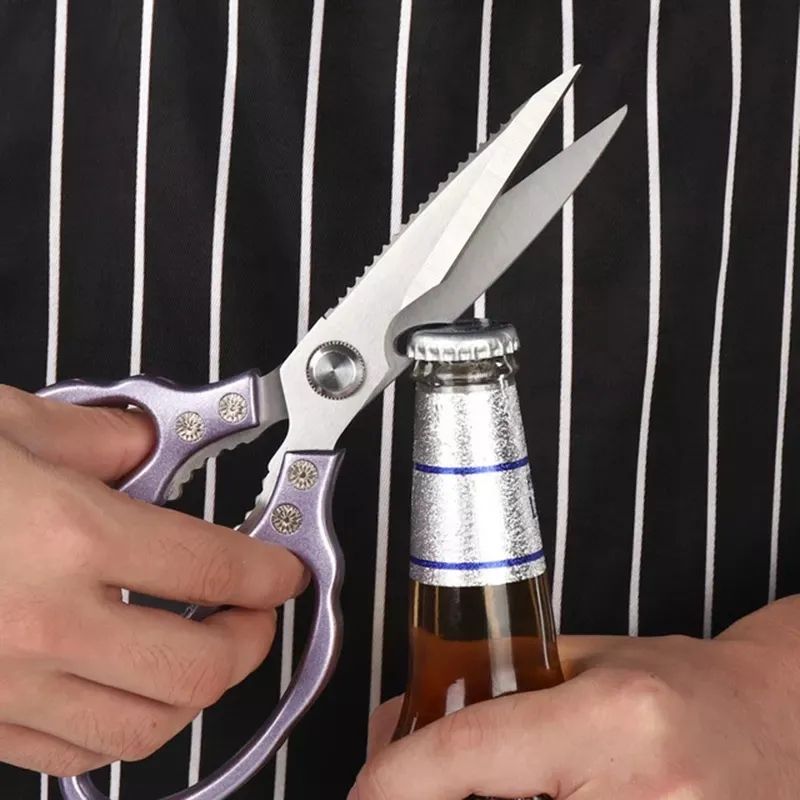
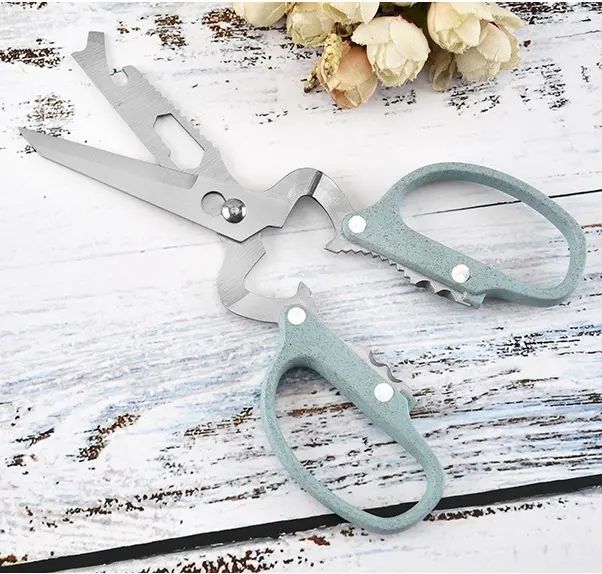
- Handle function: integrated jar and bottle openers, nut or shellfish cracker sections, and occasionally screwdriver tips.
- Comfort: handle size, finger loops, and non‑slip coating for wet environments.
Professional kitchens often stock multiple pairs—one for raw proteins, one for herbs and garnishes, and one for general packaging—to maintain hygiene and edge quality. [thesmarketers]
In some modern and traditional dining experiences, guests use scissors directly at the table, turning cutting into an interactive part of the meal. Korean barbecue restaurants commonly provide shears for cutting meat and savory pancakes, giving diners precise control over bite size and presentation.
High‑end restaurants have also experimented with table‑side scissors service, where guests portion roasted poultry, flatbread, or garnishes themselves. These examples show that when scissors are well designed and attractive, they enhance both function and the overall dining experience. [benchmarkemail]
As a manufacturer partnering with international brands, we evaluate kitchen shears not only as tools but as engineered systems that need to perform reliably in thousands of households. [thesmarketers]
From an industry perspective, four technical choices consistently determine long‑term performance:
1. Blade geometry
Thicker spines near the joint and carefully controlled taper toward the tips provide cutting power without making the scissors feel heavy.
2. Micro‑serration pattern
The spacing and depth of micro‑serrations affect how securely the blade grips chicken skin, fish, or vegetable skins without tearing them excessively.
3. Joint tolerance and torque
The pivot must be tight enough to keep blades aligned but not so tight that users experience fatigue.
4. Surface finishing and coating
Proper finishing improves corrosion resistance and ease of cleaning, especially when users place scissors in dishwashers. [thesmarketers]
User reviews consistently highlight:
- Frustration with loose, wobbly joints after a few months.
- Difficulty cleaning food residues around non‑detachable pivots.
- Discomfort when handles create pressure points during heavy cutting. [lite14]
By analyzing this feedback, OEM manufacturers can refine handle ergonomics, joint designs, and cleaning‑friendly features so that branded products earn better ratings and fewer returns. [marketveep]
Even the best kitchen scissors need basic care to stay sharp, clean, and safe.
The honest answer is: it depends on the construction and manufacturer guidance. [thesmarketers]
- Many modern stainless steel kitchen shears are designed to tolerate dishwashers, especially models with detachable blades and corrosion‑resistant coatings.
- However, repeated high‑heat cycles and collisions with other utensils can still dull the edges or damage the joint.
For premium forged or carbon steel craft scissors, hand washing with hot water and mild detergent is strongly recommended to protect both the edge and finish.
To keep scissors in peak condition:
1. Rinse and clean promptly after cutting proteins or acidic foods to avoid staining and odor.
2. Detach blades (if designed for it) and dry all surfaces thoroughly, paying attention to the joint area.
3. Store in a dedicated slot, sheath, or magnetic strip, ensuring blades do not knock against other metal tools.
4. Sharpen or service periodically, especially if you notice crushing rather than clean cutting. Professional sharpening services or manufacturer programs can extend lifespan significantly. [bigmarketing]
5. Avoid cutting hard non‑food materials (metal wire, very thick plastic) with your food scissors to preserve edge integrity.
From a user‑experience standpoint, a few simple habits make scissors safer and more effective. [productiveblogging]
1. Designate your scissors
Keep one pair strictly for food and another for packaging or household tasks.
2. Grip correctly
Place your thumb in the upper handle and two or three fingers in the lower handle for stability, keeping your wrist relaxed.
3. Cut with full strokes
Use long, smooth closing motions rather than short "chewing" cuts to reduce jagged edges and fatigue.
4. Work over bowls or pans
Snip directly over containers whenever possible to minimize mess and cross‑contamination.
5. Lock or store safely
If your shears have a safety lock, engage it before storing; otherwise, keep them in a block or sheath, out of reach of children.
The table below summarizes when each tool shines in everyday cooking. [marketveep]
| Task / Factor | Kitchen Scissors Advantage | Kitchen Knife Advantage marketveep |
|---|---|---|
| Cutting herbs and garnishes | Clean snips directly over dishes | Fine chiffonade on boards |
| Preparing bite‑size toddler food | Fast cutting on plate | Less necessary |
| Cutting raw poultry joints | Controlled pressure, bone notches | Requires more skill |
| Managing canned/jarred ingredients | Mess‑free cutting in container | More splashing, extra cleanup |
| Large vegetable prep (e.g. squash) | Limited | Strong, versatile cuts |
| Precision slicing (sashimi, carpaccio) | Limited | Essential for presentation |
If you find yourself fighting with dull plastic shears or misusing knives for jobs they are not suited for, this is the moment to upgrade to professional‑grade kitchen scissors. Choose forged, ergonomic shears designed for real kitchen tasks, and you will cook more safely, clean up faster, and enjoy the process far more—whether you are a home cook or a brand sourcing premium scissors for your customers. [bigmarketing]
1. Do I really need separate scissors for food and non‑food tasks?
Yes, it is strongly recommended to reserve at least one pair of scissors exclusively for food to prevent cross‑contamination from packaging, tape, or other materials. [thesmarketers]
2. How often should I sharpen my kitchen shears?
For home use, many users find that high‑quality shears need sharpening every 6–12 months, depending on frequency of use and what they cut; professional kitchens may require more frequent maintenance. [bigmarketing]
3. Are micro‑serrated blades better than smooth blades?
Micro‑serrated blades grip slippery foods like chicken skin or tomatoes more effectively, while smoother blades can provide cleaner cuts on herbs and thin garnishes; many chefs keep both styles.
4. Can I use kitchen scissors to cut small bones?
Multipurpose kitchen shears with strong forged blades and a bone notch can cut small poultry bones, but they are not designed for very hard or thick bones, which might damage the edge.
5. What should I look for if I have smaller hands?
Seek scissors with slightly smaller, ergonomically shaped handles, moderate spring resistance, and a balanced weight so you can maintain control without strain during longer prep sessions. [lite14]
1. Ciselier. "Quality Scissors Belong in Your Kitchen." June 11, 2022. [https://ciselier.com/blogs/news/why-you-really-need-quality-scissors-in-the-kitchen]
2. Big Marketing. "Manufacturing SEO: 10 Proven Strategies for Top Rankings." 2025. [https://bigmarketing.com/manufacturing-seo] [bigmarketing]
3. Market Veep. "4 Best Practices for Your Content SEO Strategy in Manufacturing." 2025. [https://www.marketveep.com/blog/4-best-practices-for-your-content-seo-strategy-in-manufacturing] [marketveep]
4. The Smarketers. "SEO Strategy for Manufacturers: A Beginner's Guide." 2023. [https://thesmarketers.com/blogs/the-beginners-guide-to-seo-strategy-for-manufacturers] [thesmarketers]
5. Lite14. "How to Leverage User Reviews for Blog Content Creation." 2024. [https://lite14.net/blog/2024/09/16/how-to-leverage-user-reviews-for-blog-content-creation] [lite14]
6. Productive Blogging. "15 Easy Ways to Improve Your Website's E‑E‑A‑T." 2025. [https://www.productiveblogging.com/eat] [productiveblogging]
7. Benchmark Email. "How to Get High‑Quality Insights to Enhance Your Blog Content." 2023. [https://www.benchmarkemail.com/blog/high-quality-insights-blog-content] [benchmarkemail]


