
English 


Views: 222 Author: Kingford Scissors Publish Time: 2026-05-01 Origin: Site


Scissors are usually a trusted household tool, but in horror movies they turn into one of the most unsettling weapons on screen. Unlike knives or axes, scissors feel accidental, improvised, and disturbingly realistic, which makes every close‑up of the blades far more nerve‑shredding. For directors, this "everyday object turned lethal" effect is cinematic gold, because viewers recognize scissors from their own homes.
As a professional scissors manufacturer serving global OEM clients, we watch these films with a very different eye. We see not only the jump scares, but also the design details, ergonomics, and how a tool engineered for precision cutting becomes a symbol of psychological tension and duality. That blend of familiarity and fear is exactly why scissors keep returning to horror cinema. [venveo]

Horror lovers know that once scissors appear on screen, something bad usually follows. Below are some of the most memorable film moments where scissors steal the scene.
The 1991 film *Scissors*, starring Sharon Stone, is far from a masterpiece, but it helped cement the trope of scissors as a desperate self‑defence weapon. Stone's character grabs a pair of scissors in an elevator to fight off an attacker, turning a purse item into a last‑second survival tool. The movie itself scored poorly with audiences (31% on Rotten Tomatoes), yet the image of scissors used in close quarters stuck with viewers.
For manufacturers, this scene unintentionally highlights real‑world concerns: grip comfort under stress, blade strength, and how quickly the tool can be deployed from a bag or pocket.
In the *Halloween* series, particularly the fifth film, iconic slasher Michael Myers finally brings scissors into his arsenal. While knives remain his signature, adding scissors raises the tension because they are less predictable and more visually complex on screen. The open blades catch light differently, and the double points create more unsettling compositions in tight shots.
From an industrial design angle, this kind of scene reminds us why tip shape, blade length, and handle contrast matter, even when the product is meant for home, school, or salon use rather than horror.
Jordan Peele's *Us* (2019) elevated scissors from prop to symbol. The film features eerie gold scissors used by doppelgangers who mirror the "double" nature of the blades: two halves forming a single, dangerous whole. Peele himself has said that scissors sit "between the mundane and the absolutely terrifying," and he leans into that duality visually and thematically.
As specialists in R&D and OEM manufacturing, we relate to this idea of duality: scissors must be both safe and powerful, familiar yet capable of serious work. Horror simply exaggerates this tension for dramatic impact.
Several films use scissors in short but shocking scenes that horror fans never forget:
- Dial M for Murder – Hitchcock turns scissors into a sudden reversal of power during a home invasion.
- Unhinged (2020) – A pair of scissors becomes a last‑chance defensive tool in an intense confrontation.
- Schizoid (1980) – Klaus Kinski headlines a story with serial scissor murders.
- Joker (2019) – A brutal scissor attack marks a turning point in tone, underlining how everyday tools can be terrifying.
Podcasts and critic lists such as Nightmare on Film Street's "All Sliced Up" ranking and Beyond the Void's "Scissor Slicing Scenes" continue to collect and celebrate these moments, confirming scissors as a recurring horror motif.
Horror directors use scissors not just because they are sharp, but because their design and symbolism do a lot of storytelling work.
1. Duality and the "double" theme
Scissors are literally two blades pivoting around a single point, a perfect visual metaphor for split personalities, hidden selves, or doppelgangers. Filmmakers like Jordan Peele leverage this to talk about class, identity, and inner conflict.
2. Mundane object, extreme outcome
Because scissors are in homes, offices, schools, and salons, audiences are familiar with them and understand their potential danger immediately. Turning them into a weapon amplifies the fear of ordinary spaces and routine tasks. [venveo]
3. Sound design and close‑ups
The metallic snip and the visual of blades opening and closing near eyes, throats, or fingers make viewers physically uncomfortable. Horror critics at Nightmare on Film Street even joke about tensing "every muscle" when scissors enter the frame, waiting for blades to "slice through skin."
4. Improvise‑or‑die weapon
Unlike a gun or a hunting knife, scissors show up in horror precisely because they are the thing a character can realistically grab in a moment of crisis. This connects directly to how most people actually use scissors in real life—always nearby, always ready.
As Kingford Homeware Co., Ltd., we don't make horror props—we make professional scissors used daily by brand owners, wholesalers, and manufacturers across multiple industries. Yet the movies still highlight why real‑world engineering matters.
In real manufacturing, every design decision aims for efficiency, safety, and longevity, not shock value. [venveo]
- We prioritize hardened stainless steel or alloy blades for consistent cutting performance and corrosion resistance in different environments (kitchen, salon, textile workshop, etc.).
- Geometry (hollow‑ground, micro‑serrated, convex edges) is selected based on application: precision cutting, fabric work, grooming, or heavy‑duty industrial use.
- Unlike movie props that might be dulled for safety, our blades are engineered for high cutting efficiency across thousands of cycles under controlled quality standards.
- Handle design focuses on comfort for prolonged use—finger loops, thumb rests, and surface textures that reduce fatigue.
- We pay close attention to left‑handed vs right‑handed ergonomics, something even filmmakers occasionally reference (for example, quirky scenes involving "lefty scissors").
- Safety features, from rounded tips in school scissors to blade covers and locking mechanisms in some industrial models, directly address scenarios where scissors are used around children or crowded workspaces.
Because we act as an OEM partner, we design and produce scissors tailored to specific use cases:
- Beauty and salon brands – ultra‑sharp, balanced shears with polished finishes and branding on the handles.
- Kitchenware and food processing – heavy‑duty kitchen shears, detachable blades for hygiene, anti‑slip handles.
- Textile and garment manufacturers – long‑blade dressmaker shears, thread snips, color‑coded handles for workflow management.
This is the side of scissors horror movies never show: the careful engineering that allows safe, controlled performance rather than random, cinematic violence.
Horror cinema doesn't worry about tolerances, heat‑treatment curves, or cutting force data—but those details matter deeply to professionals.
- Blade sharpness and durability
In films, scissors cut through anything, endlessly. In reality, different steels and edge types are optimized for specific materials, and blades require maintenance, cleaning, and periodic sharpening.
- Joint stability
Many on‑screen scissors swing open and closed with exaggerated ease for dramatic effect. Real high‑quality scissors maintain a carefully calibrated pivot tension so that blades meet precisely, preventing snagging or folding of material.
- Safety context
Professional environments—from factories to salons—adhere to safety training and storage practices, making random scissor violence extremely unlikely. Horror uses scissors as a storytelling shortcut, not a realistic workplace scenario. [foremostmedia]
At the same time, movies do sometimes capture the concentration and control involved in using scissors, especially in scenes with tailors, barbers, or artisans. That part is authentic: precision cutting is a craft.
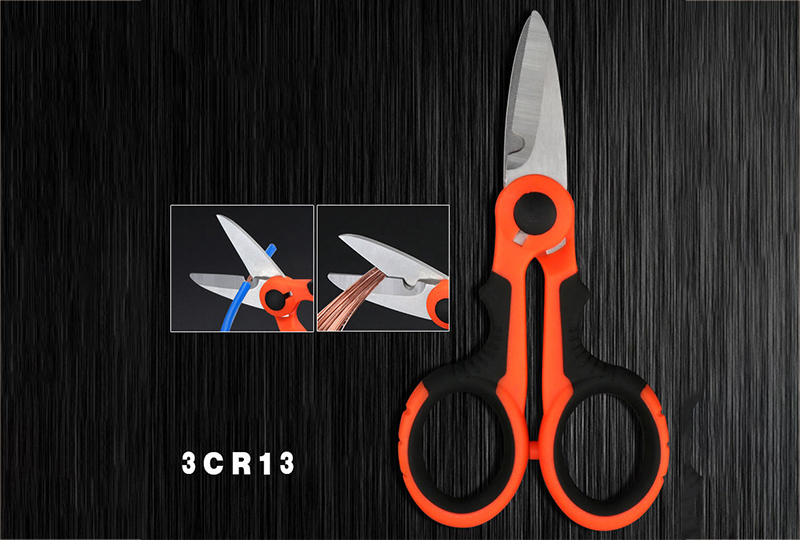
Because we design scissors for real users, not fictional killers, we approach safety with a structured, engineering‑driven mindset.
Based on our long‑term OEM experience, these are the key principles we emphasize to partners and end users:
1. Match the tool to the task
Use kitchen shears in the kitchen, barber shears in the salon, and industrial cutters on the factory floor. Misuse is one of the most common sources of accidents in real life.
2. Prioritize ergonomics and training
Ensure staff know how to handle, hand over, and store scissors properly, particularly in environments with high throughput or shared workstations.
3. Implement clear storage and transport rules
In factories and workshops, defined storage areas and protective sheaths greatly reduce accidental injuries and tool loss.
4. Maintain the blades
Clean scissors regularly, especially in food, medical, or textile environments; schedule sharpening rather than pushing dull tools past their limits, which can cause slipping and unexpected force.
If horror movies trigger your awareness of "how dangerous scissors could be," professional design does the opposite: it focuses that potential into controlled, productive performance.
As a full‑service OEM scissors manufacturer, we help brands transform a simple tool into a differentiated product line that feels premium, safe, and trustworthy—very different from the chaotic way scissors appear on screen.
We support brand owners with:
- Co‑developed designs aligned with target users (home, professional, industrial).
- Sample iterations that test balance, handle comfort, and cutting performance.
- Custom finishes, colors, and branding to match your positioning—without compromising functionality.
To earn trust across markets, we emphasize:
- Material traceability and standardized hardness and durability testing.
- Batch inspections for blade alignment, cutting force, and handle strength.
- Compliance with relevant safety standards in your destination markets.
While horror movies use scissors to symbolize chaos, our production uses rigorous process control to ensure every pair behaves predictably and safely in real hands.
For wholesalers and industrial clients, we help plan:
- Tiered product lines (good/better/best) to reach multiple price points.
- Packaging strategies that highlight key features and safety messages.
- Lifecycle planning, from launch to feedback‑driven upgrades and new variants.
Watching a horror film probably makes you think more seriously about the scissors you actually own. Here are simple, professional‑grade criteria to use the next time you source or select scissors.
| Factor | What To Look For (Manufacturer's View) |
|---|---|
| Application | Clear use case: kitchen, office, salon, textile, industrial. |
| Blade material | Hardened stainless or alloy steel suitable for your environment and workloads. |
| Edge type | Straight, micro‑serrated, or convex edges matched to materials you cut most often. |
| Handle ergonomics | Comfortable grip, correct handedness, anti‑slip surfaces for long sessions. |
| Safety features | Rounded tips (if needed), blade covers, secure pivot, stable feel under pressure. |
| OEM customization | Branding, finishes, special colors, or packaging for your target market. |
Using a checklist like this brings the conversation back from cinematic fear to everyday performance and safety—where professional scissors truly shine.
If horror films have reminded you how powerful a simple pair of scissors can be, now is the ideal time to ensure your own products are engineered, branded, and manufactured to a professional standard. As a dedicated OEM scissors manufacturer, Kingford Homeware Co., Ltd. supports global brand owners, wholesalers, and producers from concept design to mass production, focusing on safety, durability, and market differentiation.
If you are looking for a reliable OEM partner for high‑quality scissors—whether for home, professional, or industrial use—contact our team to discuss your project requirements, request samples, or start a custom design brief today.
Q1: Why do horror movies use scissors so often as a weapon?
A1: Scissors are familiar, easily available, and visually expressive—two blades, a pivot, and sharp tips—so they instantly signal danger while still feeling realistic to audiences.
Q2: Are the scissors shown in movies similar to real professional scissors?
A2: Not usually. On‑screen scissors are often modified props, while real professional scissors are engineered with precise blade geometry, specific steels, and strict safety and durability standards. [venveo]
Q3: What should brands consider when developing their own scissor line?
A3: Start with the core application, define the target user (home, salon, industrial), then align blade material, ergonomics, safety features, and branding with those needs; partnering with an experienced OEM simplifies this process. [robertsiegers]
Q4: How does a manufacturer demonstrate expertise and trustworthiness online?
A4: By sharing first‑hand insights, technical explanations, case studies, clear safety guidance, and transparent information about materials and quality control, all aligned with Google's E‑E‑A‑T principles. [wgcontent]
Q5: Can one manufacturer supply different types of scissors for multiple industries?
A5: Yes. A full‑service OEM like Kingford Homeware Co., Ltd. can design and produce tailored scissors for kitchen, beauty, office, textile, and industrial use, adjusting materials, finishing, and packaging for each segment. [venveo]
1. Ciselier – "When Scissors go to the (Horror) Movies" (original article and film references).
<https://ciselier.com/blogs/news/when-scissors-go-to-the-horror-movies>
2. WG Content – "E‑E‑A‑T for content quality: show experience, expertise and authority."
<https://wgcontent.com/blog/eeat-content-quality-seo-geo/>
3. SEO for Manufacturers – "Strategies to Dominate Search in 2025."
<https://robertsiegers.com/en/seo-for-manufacturers>
4. Venveo – "SEO For Manufacturing Companies: Content and authority best practices."
<https://www.venveo.com/blog/content-marketing/seo-for-manufacturing-companies>
5. Big Business Agency – "Top Strategies to Improve Google Ranking with Blog Content in 2024."
<https://bigbusinessagency.com/insights/top-strategies-to-improve-google-ranking-with-blog-content-in-2024>
6. Foremost Media – "Google's E‑E‑A‑T and Manufacturing Websites."
<https://www.foremostmedia.com/resources/blog/posts/how-to-take-advantage-of-google-e-e-a-t-for-manufacturing-websites>
7. Yoast – "Tips and tricks to write SEO‑friendly blog posts in the AI era."
<https://yoast.com/seo-friendly-blog-post/>


