
English 


Views: 222 Author: Kingford Scissors Publish Time: 2026-04-30 Origin: Site


There are two kinds of home cooks and food professionals: those who already rely on kitchen scissors every day, and those who simply haven't discovered how powerful a pair of well‑designed kitchen shears can be. [atthetable.co]
As a professional scissor manufacturer supplying OEM kitchen scissors to global brands, we see every stage of this tool's life cycle—from design and material selection to real‑world testing in busy kitchens. This article combines that industry experience with practical, step‑by‑step guidance, so you can understand not only the top 5 uses for kitchen scissors, but also what makes a high‑quality pair worth trusting with your food. [insight-kitchenknife]

Before diving into the top 5 uses, it helps to understand why professional chefs and serious home cooks consider kitchen shears indispensable. [fvtc]
- They save time by letting you cut directly over pots, pans, and plates. [themountainkitchen]
- They improve safety by reducing awkward cutting angles and slippery cutting boards. [fvtc]
- They increase precision for small ingredients like herbs, scallions, or seafood. [cutco]
- They keep your knives sharper by handling the "dirty work" like packaging, bones, shells, and cartilage. [chefalli]
From our factory testing, we often see that once users get used to a good pair of shears, they reach for scissors first and knives second for everyday kitchen prep. [chefalli]
In the original article, the brand introduced a video series showing five core use cases for kitchen scissors: ditching the cutting board, cutting fish, general prep, shelling lobster, and spatchcocking chicken. Below, we expand each use with practical detail and professional tips. [cutco]
One of the simplest ways to transform your workflow is to cut directly over the pot or bowl. Instead of dragging out a cutting board and extra knife, you can snip ingredients straight into your cooking vessel. [themountainkitchen]
Best tasks for "no cutting board" prep: [themountainkitchen]
- Cutting green onions and chives into soups, stir‑fries, and omelettes
- Snipping fresh herbs like parsley, cilantro, basil, or dill into salads and sauces
- Cutting tortillas, pitas, or flatbreads into strips or wedges for chips or croutons
- Trimming bacon, ham, or deli meats into bite‑sized pieces directly into a pan
How to do it safely: [insight-kitchenknife]
1. Hold the ingredient in one hand and the scissors in the other.
2. Keep your fingertips curled slightly away from the blades.
3. Use short, controlled snips instead of long, sweeping cuts.
4. Aim the cut pieces directly into the pan, bowl, or serving dish.
From a manufacturing standpoint, this use case demands sharp micro‑serrated blades that grip slippery ingredients and a comfortable handle for repeated cutting motions. [insight-kitchenknife]
Cutting fish can be messy and intimidating with a knife, especially for beginners. Quality kitchen scissors for fish give you better control over delicate flesh, skin, and bones. [cutco]
Common fish‑related tasks where scissors excel: [cutco]
- Trimming fins and tails
- Cutting through small bones and cartilage
- Portioning fillets into uniform pieces
- Snipping herbs and aromatics directly onto fish before steaming, baking, or grilling
Expert tips from the factory floor: [insight-kitchenknife]
- Look for blades with high‑carbon stainless steel and a slightly curved profile for cleaner fish cuts.
- A detachable blade design makes it easier to deep‑clean after working with raw seafood.
- Oversized, non‑slip handles improve control when your hands are slightly wet or greasy.
Most home cooks underestimate how versatile kitchen scissors are for daily kitchen prep. [themountainkitchen]
Use your shears for:
- Snipping broccoli florets into smaller pieces
- Cutting cherry tomatoes or grapes into halves (great for kids' lunches)
- Cutting raw bacon into lardons without dirtying a board
- Making long noodles bite‑sized for children or elderly family members
- Cutting large marshmallows into smaller pieces for baking or toppings
Compared with a knife, scissors provide point‑and‑cut precision, especially for irregular shapes, small items, or when working directly inside a bowl or casserole dish. [chefalli]
Engineers in our R&D department pay special attention to blade tip geometry here: a slightly rounded yet narrow tip enhances control while reducing the risk of accidental punctures in bags, pans, or fingers. [insight-kitchenknife]
Shellfish is where heavy‑duty kitchen shears truly show their value. Cutting through lobster shells, crab legs, or prawn shells can be tough on regular tools, but properly engineered scissors make it efficient and far safer. [chefalli]
How to use scissors on lobster or crab: [cutco]
1. Use the heel of the blades (the thickest part near the pivot) to start cuts on tough shell sections.
2. Snip along the natural seams of the shell rather than directly across the hardest ridges.
3. Use short, repeated cuts instead of forcing the blades, protecting both your hand and the hinge.
4. Once the shell is opened, use the tips to gently free delicate meat.
From a manufacturer's perspective, this is a stress test for: [insight-kitchenknife]
- Blade hardness and edge retention under high pressure
- Hinge strength, including the screw or rivet system
- Grip ergonomics, so your hand doesn't fatigue during repeated strong cuts
If your brand targets seafood‑loving markets, specifying reinforced blades with serrations and robust pivots in your OEM kitchen shears can be a major differentiator. [insight-kitchenknife]
Spatchcocking a chicken—removing the backbone so it lies flat—helps poultry cook faster and more evenly, with crispier skin. A strong pair of poultry shears makes this job straightforward even for home cooks. [fvtc]
How to spatchcock a chicken with kitchen scissors: [chefalli]
1. Place the chicken breast‑side down on a stable surface.
2. Starting at the tail, cut up one side of the backbone using the scissors.
3. Repeat on the other side to remove the backbone completely.
4. Flip the chicken over and press firmly on the breastbone to flatten it.
5. Use the shears to trim excess fat, loose skin, or wing tips.
For this application, our OEM partners typically request: [insight-kitchenknife]
- Heavy‑duty blades with a thicker spine
- Micro‑serrations for gripping slippery poultry skin
- A spring‑assist mechanism or optimized leverage for easier one‑handed cutting
To truly outperform competing content, it's important to go beyond the original five uses and address more advanced, real‑world applications. [techwyse]
Most households already use scissors to open food packages, but purpose‑built kitchen shears are safer and more hygienic than office scissors. [fvtc]
Use them to:
- Open vacuum‑sealed meat packs without damaging the product
- Cut parchment, baking paper, or foil to exact pan sizes
- Trim butcher's twine after tying roasts
- Snip open bags of frozen vegetables or snacks
From a UX standpoint, this is where detachable blades and dishwasher‑safe designs significantly reduce cross‑contamination risk between packaging and food prep. [insight-kitchenknife]
Kitchen scissors are particularly helpful for families and caregivers who need to customize food texture and size. [cutco]
Practical examples:
- Cutting cooked noodles, pancakes, or sandwiches into bite‑sized pieces for toddlers
- Trimming tough edges or crusts for elderly diners with chewing difficulties
- Quickly portioning cooked meat into smaller, easier‑to‑chew pieces
- Customizing portion sizes while plating, without dirtying extra boards or knives
In product testing, we often observe that these users benefit from soft‑touch handles, moderate blade length, and a gentle opening resistance, which reduce hand strain over multiple cuts. [insight-kitchenknife]
A robust pair of kitchen scissors also shines outside the traditional kitchen. [fvtc]
Ideal outdoor uses include:
- Cutting herbs from a garden directly into a grill marinade bowl
- Trimming fat or portioning meat at a barbecue station
- Opening charcoal bags, seasoning packets, and grill accessory packaging
- Cutting skewers, twine, or foil to size for campfire cooking
For OEM buyers working with outdoor or BBQ brands, specifying corrosion‑resistant alloys, non‑slip grips, and easy‑clean blades is key for users who cook outside in humid or harsh conditions. [insight-kitchenknife]
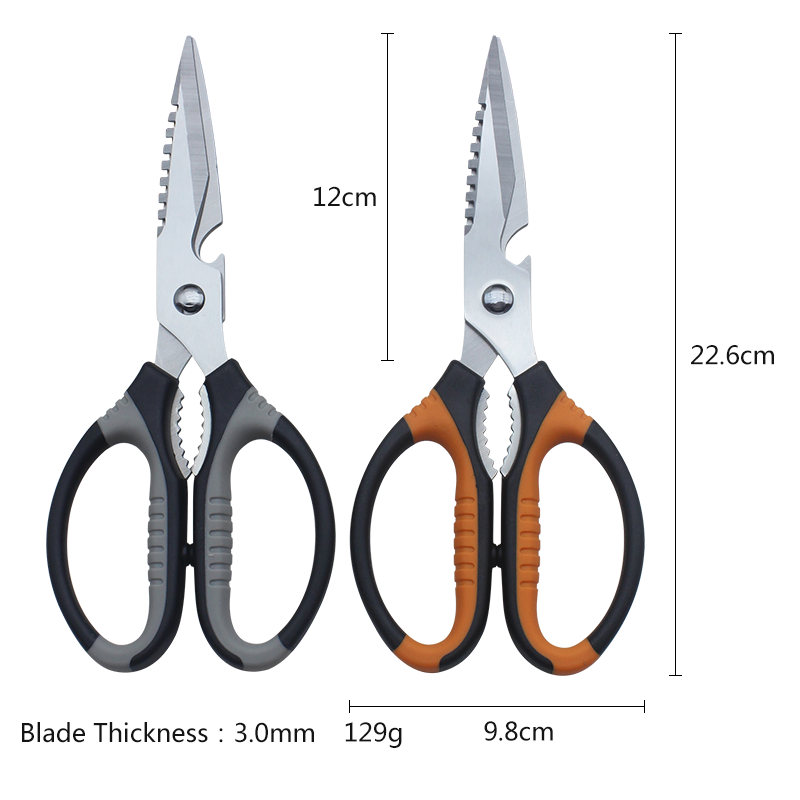
Most online articles talk about uses, but rarely explain how to evaluate kitchen scissor quality from a technical perspective. As a manufacturer, we test hundreds of prototypes to ensure long‑term performance. [insight-kitchenknife]
| Feature | Why It Matters | Expert Note |
|---|---|---|
| Blade material | High‑carbon stainless steel offers sharpness and corrosion resistance. (insight-kitchenknife) | Ideal for repeated contact with acidic foods and dishwashing. (insight-kitchenknife) |
| Hardness & edge retention | Maintains sharpness after cutting bone, shell, and packaging. (insight-kitchenknife) | Too soft dulls quickly; too hard may chip on bone. (insight-kitchenknife) |
| Micro‑serrations | Grip slippery ingredients like poultry skin and fish. (insight-kitchenknife) | Common on one blade; the other is smooth for clean cuts. (insight-kitchenknife) |
| Handle ergonomics | Reduces hand fatigue during long prep sessions. (insight-kitchenknife) | Ambidextrous, soft‑grip handles suit more users. (insight-kitchenknife) |
| Detachable design | Allows deep cleaning and sharpening. (insight-kitchenknife) | Critical for raw meat and seafood hygiene. (insight-kitchenknife) |
| Safety lock | Keeps blades closed during storage. (insight-kitchenknife) | Important for families with children. (insight-kitchenknife) |
By communicating these features clearly on your product pages and packaging, you strengthen both E‑E‑A‑T signals for your brand and user trust in your scissors. [stellarcontent]
Proper care not only protects users but also extends product life—important for brand reputation and warranty performance. [insight-kitchenknife]
- Detach the blades (if your model supports it) before cleaning. [insight-kitchenknife]
- Wash with warm, soapy water immediately after cutting raw meat or fish. [insight-kitchenknife]
- If dishwasher‑safe, place in the top rack and avoid high‑heat drying cycles that may affect handles. [insight-kitchenknife]
- Dry thoroughly and store in a clean, dry place to prevent corrosion. [insight-kitchenknife]
- Use a dedicated scissor sharpener or professional sharpening service rather than a knife sharpener. [insight-kitchenknife]
- If you notice blade looseness, adjust the pivot screw carefully, tightening just enough to restore smooth cutting without stiffness. [insight-kitchenknife]
- Keep scissors out of reach of children; use a locking mechanism or blade cover. [insight-kitchenknife]
- Avoid using kitchen scissors on non‑food materials like wire or hard plastics, which can damage edges. [insight-kitchenknife]
- Replace scissors if you notice rust, severe pitting, or misalignment that cannot be corrected. [insight-kitchenknife]
Because we work closely with international brands, wholesalers, and manufacturers, we understand what professional buyers prioritize when sourcing OEM kitchen scissors. [insight-kitchenknife]
- What steel grade is used for the blades, and how is it heat treated? [insight-kitchenknife]
- Are the scissors food‑contact certified for target markets (e.g., LFGB, FDA contact requirements where applicable)? [insight-kitchenknife]
- Can you provide test reports on corrosion resistance, cutting performance, and handle durability? [insight-kitchenknife]
- What customization options are available for handle color, surface finish, logo, and packaging? [insight-kitchenknife]
- What is the proven lifecycle (average cuts before sharpening) under standard test conditions? [insight-kitchenknife]
A clear technical and compliance narrative not only supports SEO and E‑E‑A‑T but also shortens the decision‑making cycle for professional buyers visiting your site. [techwyse]
If you are a brand owner, wholesaler, or cookware manufacturer looking to add or upgrade kitchen scissors in your product line, partnering with an experienced OEM scissor factory gives you a powerful advantage. [insight-kitchenknife]
At Kingford Homeware Co., Ltd., we:
- Focus exclusively on research, development, production, and sales of high‑quality scissors. [insight-kitchenknife]
- Offer OEM and ODM services for global kitchenware brands across multiple market segments. [insight-kitchenknife]
- Support you with engineering consultation, packaging design, and quality documentation tailored to your target markets. [insight-kitchenknife]
Ready to develop your next best‑selling kitchen scissors?
Contact our expert team to discuss blade specifications, handle designs, and private‑label options, and let's build a product that your customers reach for every single day. [insight-kitchenknife]
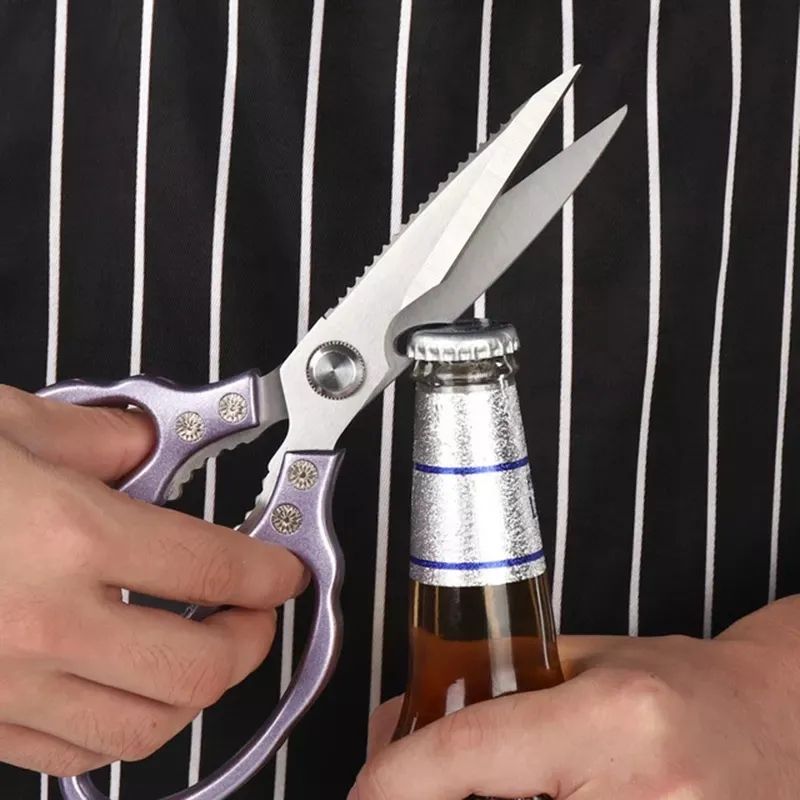
Q1: Are kitchen scissors safe to use on raw meat and poultry?
Yes, as long as they are made from food‑grade stainless steel and cleaned thoroughly after each use, kitchen scissors are safe for raw meat and poultry. A detachable design further improves hygiene by allowing deep cleaning of the pivot area. [cutco]
Q2: Can I put my kitchen scissors in the dishwasher?
Many modern kitchen scissors are dishwasher‑safe, but it depends on the materials and construction. Check the manufacturer's instructions; even for dishwasher‑safe models, hand‑washing and immediate drying will usually extend the product's life. [insight-kitchenknife]
Q3: What is the difference between regular scissors and kitchen scissors?
Regular office scissors are not designed for food contact or heavy loads like bone, shell, or cartilage. Kitchen scissors typically use higher‑grade stainless steel, have stronger hinges, ergonomic handles, and sometimes micro‑serrated blades for better grip on slippery ingredients. [insight-kitchenknife]
Q4: How often should I sharpen my kitchen scissors?
The frequency depends on usage, but for average home use, sharpening once or twice a year is often enough. In commercial or high‑volume kitchens, more frequent sharpening may be needed, and choosing a higher‑hardness blade material helps extend intervals between sharpenings. [insight-kitchenknife]
Q5: What features should I prioritize when sourcing OEM kitchen scissors for my brand?
Focus on blade material and hardness, handle ergonomics, detachable design for cleaning, and safety features like locks or covers. Ask your supplier for test data on cutting performance, corrosion resistance, and handle durability to ensure consistent quality for your customers. [insight-kitchenknife]
1. Ciselier. "Video How‑To: Top 5 Uses for Kitchen Scissors."
https://ciselier.com/blogs/news/video-how-to-top-5-uses-for-kitchen-scissors
2. Bee Wilson. "Kitchen Scissors." At The Table.
https://atthetable.co.uk/editorial/kitchen-scissors [atthetable.co]
3. Cutco. "12 Great Uses for Kitchen Shears."
https://cutco.com/learn/great-uses-for-kitchen-shears [cutco]
4. The Mountain Kitchen. "5 Uses for Kitchen Scissors."
https://www.themountainkitchen.com/5-uses-for-kitchen-scissors/ [themountainkitchen]
5. Chef Alli. "10 Clever Uses for Kitchen Shears."
https://chefalli.com/10-clever-uses-for-kitchen-shears/ [chefalli]
6. Insight Kitchen Knife. "What Are the Key Features of High‑Quality Kitchen Shears?"
https://www.insight-kitchenknife.com/zh-CN/what-are-the-key-features-of-high-quality-kitchen-shears.html [insight-kitchenknife]
7. TechWyse. "EEAT and User Experience: How to Create Content That Builds Trust and Keeps Visitors Engaged."
https://www.techwyse.com/blog/digital-marketing-101/eeat-and-user-experience-how-to-create-content-that-builds-trust-and-keeps-visitors-engaged [techwyse]
8. Stellar Content. "The Complete Guide to Google E‑E‑A‑T: How to Improve SEO."
https://www.stellarcontent.com/blog/seo/the-complete-guide-to-google-e-a-t-what-is-it-why-is-it-and-how-do-you-create-it/ [stellarcontent]
9. Fox Valley Technical College. "Don't Forget the Kitchen Scissors."
https://www.fvtc.edu/news/story/dont-forget-the-kitchen-scissors [fvtc]


