
English 


Views: 222 Author: Amanda Publish Time: 2026-02-13 Origin: Site


Content Menu
● What Are Kitchen Scissors and Why They Matter
● Top Everyday Uses for Kitchen Scissors (No Cutting Board Needed)
>> 1. Snipping Fresh Herbs Directly Into the Dish
>> 2. Cutting Vegetables and Salad Ingredients
>> 3. Trimming and Portioning Meat and Poultry
>> 4. Spatchcocking (Butterflying) Chicken
>> 5. Prepping Seafood: Fish, Shrimp and Shellfish
>> 6. Cutting Pizza, Flatbreads and Quesadillas
>> 7. Kid-Friendly Portions and Bite-Size Cuts
● Step-by-Step: Using Kitchen Scissors for a Full Meal
● Safety Best Practices When Using Kitchen Scissors
>> Cross-Contamination Prevention
● Cleaning and Maintaining Kitchen Scissors
>> Sharpening and Performance Checks
● Choosing the Right Kitchen Scissors (For Home, Brands and Wholesalers)
● How Kitchen Scissors Improve Kitchen Workflow
>> Benefits vs Traditional Knife-Only Prep
● When You Still Need a Cutting Board
● Partner With Kingford Homeware Co., Ltd. for OEM Kitchen Scissors
>> FAQ 1: Are kitchen scissors safe to use on all foods?
>> FAQ 2: Can I put my kitchen scissors in the dishwasher?
>> FAQ 3: How often should I sharpen kitchen scissors?
>> FAQ 4: What is the difference between kitchen scissors and regular scissors?
>> FAQ 5: Why should brands add kitchen scissors to their product line?
Kitchen scissors (also called kitchen shears) are one of the most underrated tools in a modern kitchen, yet they can dramatically speed up prep, reduce mess and improve safety when used correctly. As an OEM scissors manufacturer, Kingford Homeware Co., Ltd. knows that high-quality, well-designed kitchen scissors can replace multiple tools and help both home cooks and professionals work more efficiently.
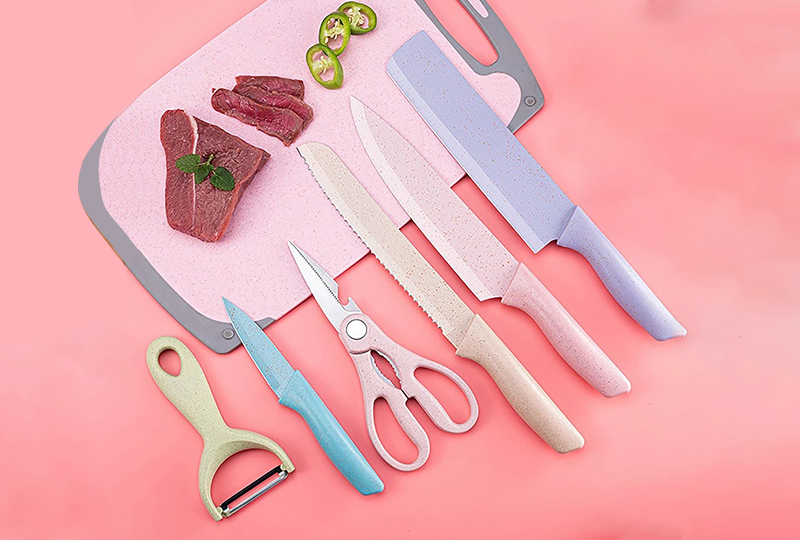
Kitchen scissors are purpose-built cutting tools designed for food prep, featuring sturdy blades, ergonomic handles and often detachable parts for easy cleaning. Unlike office scissors, they are made from food-safe, corrosion-resistant stainless steel and engineered to handle everything from herbs to poultry bones.
Their key advantages include:
- Faster prep without constantly switching tools.
- Less reliance on a cutting board, so fewer dishes to wash.
- Better control for small, slippery or irregular ingredients.
- Versatile use, from snipping herbs to spatchcocking chicken.
Kitchen scissors allow you to prep directly over the pot, pan or plate, cutting mess and saving time. Below are some of the most efficient cutting-board-free uses.
Instead of bunching herbs on a board and using a knife, hold them over your pan, bowl or plate and snip directly with kitchen scissors. This reduces bruising, keeps chopping uniform and eliminates the need to scrape herbs off a board.
Popular examples include:
- Chives over scrambled eggs or baked potatoes.
- Basil over pasta or pizza.
- Cilantro over soups, curries and tacos.
Many salad and stir-fry ingredients can be cut with scissors straight into the serving bowl or wok. This is especially useful for:
- Green onions and leeks.
- Lettuce, kale and leafy herbs for chopped salads.
- Cherry tomatoes, snipped into halves or quarters.
Hold the vegetable firmly and use short, controlled cuts for even pieces.
Kitchen scissors excel at precision trimming and light butchery tasks. You can:
- Trim excess fat from steaks or pork chops.
- Cut chicken tenders into bite-size pieces directly into a pan.
- Remove skin or fat from poultry with more control than a knife.
This reduces cross-contamination from multiple surfaces and makes handling raw meat safer and cleaner.
For spatchcocking, use strong kitchen scissors to cut along both sides of the backbone, then press the bird flat. This technique:
- Shortens roasting time.
- Promotes even cooking and crispier skin.
- Offers more control and safety than using a large chef's knife.
Choose shears with robust blades and comfortable handles so you can apply steady pressure without straining your hand.
Kitchen scissors simplify many seafood tasks. You can:
- Trim fins and tails on whole fish.
- Split shrimp shells down the back for easy deveining.
- Cut through lobster shells or crab legs to expose the meat.
Always use dedicated food-only scissors for raw seafood and clean thoroughly after use.
Many kitchen experts now prefer scissors over pizza wheels because they are gentler on pans and cutting boards. Scissors:
- Cut cleanly through crust, cheese and toppings.
- Avoid scratching baking steels, pizza stones or pans.
- Let you portion slices directly on a serving board or plate.
Hold the pizza steady with tongs or a spatula and cut from the center outward for even wedges.
Parents often use kitchen scissors to quickly cut food into toddler-friendly pieces right in the bowl or on the plate. Common uses include:
- Cutting pasta, noodles or long vegetables into short lengths.
- Snipping cooked chicken, fruit or sandwiches into bite-size pieces.
- Quickly portioning leftovers for lunchboxes.
This method reduces mess, saves time and gives more precise control than a fork and knife combination.
To illustrate how versatile scissors can be, here is a streamlined workflow for a simple pasta dish inspired by classic Italian flavors.
1. Prep aromatics with scissors
Snip garlic cloves (if they are not too small), chili peppers and herbs directly into small bowls.
2. Open and portion ingredients
Use scissors to open canned tomatoes, anchovy tins and olive pouches, then snip larger pieces, such as whole tomatoes, directly into the pan.
3. Trim and portion add-ins
Cut olives and capers into halves if you want a more even distribution.
4. Finish with fresh herbs
Once the pasta and sauce are combined, hold basil or parsley over the pan and snip in fresh.
5. Serve and adjust
At plating, cut long pasta strands for children or guests who prefer shorter lengths.
This workflow shows how you can significantly reduce reliance on a cutting board while keeping prep fast and efficient.
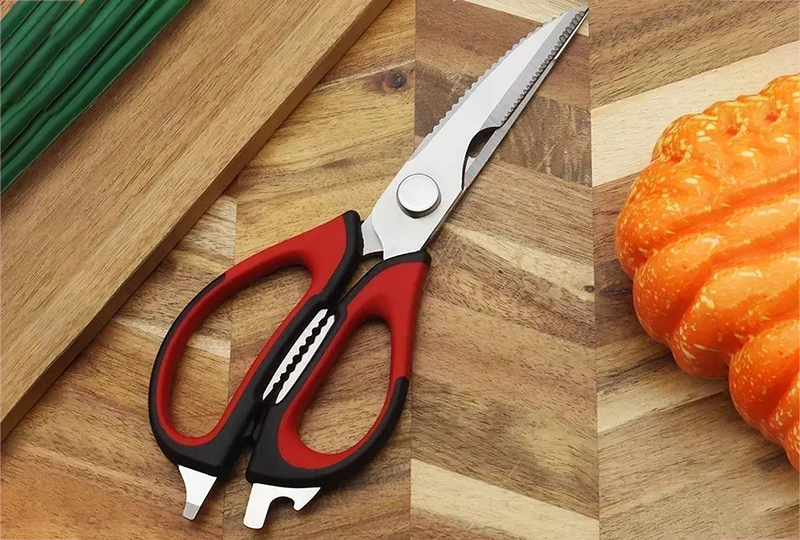
Using scissors correctly is essential for both performance and safety.
- Keep scissors sharp, because dull blades require more force and increase the risk of slips and injuries.
- Cut away from your body and fingers at all times.
- Maintain a firm grip on both handles and the food for better control.
- Do not use kitchen scissors on hard, inappropriate materials such as frozen bones, metal or thick plastic that can chip or bend blades.
- Store scissors in a closed position and out of children's reach.
Because scissors come into close contact with meats, seafood and vegetables, good hygiene is critical.
- Reserve separate scissors for raw meat and general use, or wash thoroughly between tasks.
- Clean hinges and serrated edges where food particles can lodge.
- If dishwasher-safe, place them blade-down and fully open, following the manufacturer's instructions.
Well-maintained scissors last longer and perform more consistently, an important consideration for professional buyers and OEM partners.
- Rinse immediately after use to prevent food from drying on the blades.
- Wash with warm soapy water, paying attention to the pivot area and serrations.
- Dry completely before storage to avoid corrosion and staining.
Many modern kitchen scissors feature detachable blades so you can separate them for deep cleaning and better sanitation.
Some users maintain sharpness by cutting through folded foil or using a whetstone, depending on blade design. Regular checks should include:
- Smooth, even cutting without snagging.
- No visible gaps when blades are closed.
- A tight but moveable pivot that is not excessively loose.
If scissors feel rough, misaligned or visibly damaged, replace or service them to maintain safety.
For foreign brand owners, wholesalers and manufacturers sourcing OEM kitchen scissors, understanding key specifications helps align product quality with market expectations.
- Blade material: Food-grade stainless steel for corrosion resistance and durability.
- Handle design: Ergonomic, non-slip handles that fit a wide range of hand sizes.
- Detachable structure: Blades that separate for cleaning and drying, essential in professional and home kitchens.
- Additional functions: Built-in nut-cracker jaws, bottle opener or herb stripper, depending on your audience.
- Safety features: Rounded tips or blade covers for families with children and high-traffic kitchen environments.
Use Case | Recommended Design Features |
Home family kitchen | Rounded tips, soft-touch handles, dishwasher-safe build. |
Professional restaurant kitchen | Heavy-duty blades, detachable design, high hardness steel. |
Seafood or butchery focus | Micro-serrated edge, strong pivot, high cutting force. |
Kids' meals and snack prep | Medium-size scissors, excellent grip, protective covers. |
A specialized OEM like Kingford Homeware Co., Ltd. can customize these specifications, including blade thickness, handle color, branding and packaging, to match your target market and price segment.
Kitchen scissors are not just a convenient gadget, they can be part of a lean, efficient prep system in both home and professional kitchens.
- Speed: Many small cuts, such as herbs, bacon and dried fruit, are faster with scissors than repeated knife strokes.
- Less cleanup: You can often work directly over pots and plates instead of using multiple cutting boards.
- Control: Scissors offer pinpoint accuracy for delicate tasks, such as trimming dough, pastry or garnishes.
- Safety for beginners: New cooks and kids, under supervision, find scissors more intuitive and less intimidating than large knives.
By incorporating scissors into standard prep routines, kitchens can reduce prep time and improve consistency from dish to dish.
Even though this guide champions “goodbye, cutting board” for many tasks, some jobs still require a board and knife. You should use a cutting board when:
- Breaking down very large cuts of meat or whole roasts.
- Chopping large, dense vegetables such as whole squash or large onions.
- Needing perfect, uniform dice for professional presentation.
The most efficient kitchens use a hybrid approach, using scissors for direct, small and medium tasks, and knives plus boards for heavy-duty or highly precise cuts.
If you are a foreign brand owner, wholesaler or manufacturer looking to expand your kitchen tool portfolio, high-performance kitchen scissors are a proven value-add for your product line. Kingford Homeware Co., Ltd. specializes in OEM kitchen scissors with customizable materials, designs, packaging and branding to meet different market standards and channel needs.
We support:
- Private-label kitchen scissors for retail and e-commerce.
- Tailored designs for restaurant supply and hospitality channels.
- Long-term, reliable OEM cooperation with stable quality and capacity.
Ready to create your own line of professional kitchen scissors that customers will reach for every day? Contact Kingford Homeware Co., Ltd. now to discuss your OEM project requirements and start developing a product that reflects your brand's quality, style and market positioning.
Contact us to get more information!
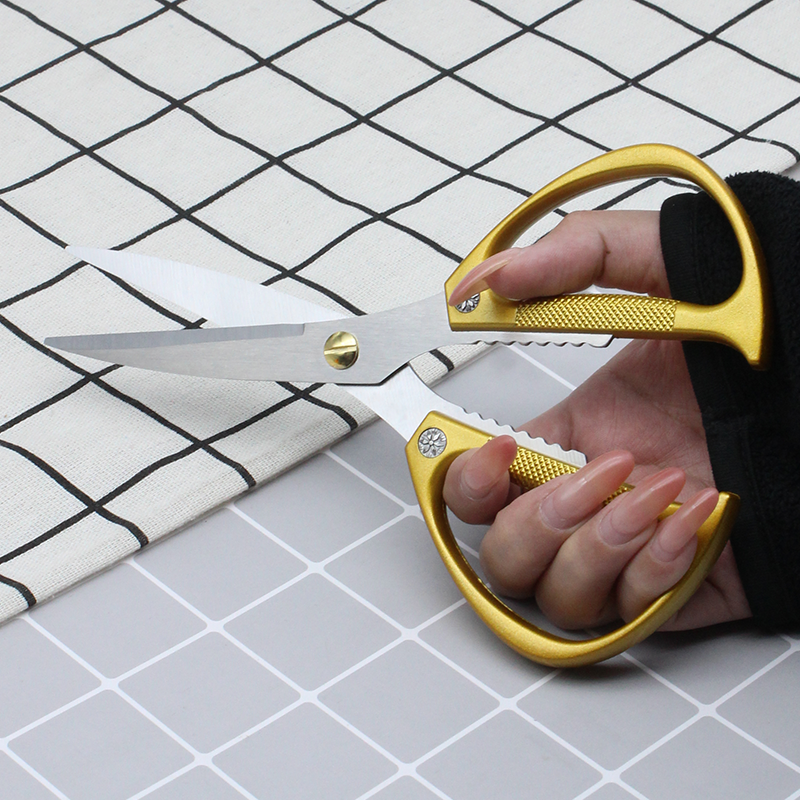
Kitchen scissors are safe for most foods, including herbs, vegetables, boneless meats and light bones, as long as they are made from food-safe materials and used correctly. Avoid extremely hard materials that could damage blades, and always clean scissors thoroughly between raw and ready-to-eat foods.
Many stainless steel kitchen scissors are marketed as dishwasher-safe, but hand washing is recommended to maximize blade life and prevent corrosion. Always check the manufacturer's instructions, and if using a dishwasher, ensure scissors are opened fully and dried completely afterwards.
The ideal sharpening frequency depends on how often you use the scissors and what you cut, but regular home use usually requires only occasional touch-ups. If you notice tearing instead of clean cuts or you need more force than usual, it is time to sharpen or service them.
Kitchen scissors are designed with food-grade materials, stronger pivots and blades, and often detachable construction for cleaning, whereas regular office scissors are not made for food contact and can corrode or break more easily. Using non-kitchen scissors for food can be unsafe and unhygienic.
Kitchen scissors are compact, highly practical and easy for customers to understand, making them an excellent upsell or bundle item with cookware and knife sets. For brands and wholesalers, they offer strong perceived value relative to manufacturing cost, especially when produced by a specialized OEM like Kingford Homeware Co., Ltd.
1. https://ciselier.com/blogs/news/how-to-use-kitchen-scissors-goodbye-cutting-board
2. https://www.themountainkitchen.com/5-uses-for-kitchen-scissors/
3. https://www.dioro.com/blogs/news/kitchen-scissors
4. https://www.restaurantware.com/blogs/smallwares/best-uses-of-kitchen-shears
5. https://yakushiknives.com/blogs/yakushi-blog-all-thing-knives/do-chefs-really-use-kitchen-shears-discover-their-uses
6. https://www.cnet.com/home/kitchen-and-household/how-to-use-kitchen-shears/
7. https://dalstrong.com/blogs/news/do-you-really-need-kitchen-scissors
8. https://kansaslivingmagazine.com/articles/2022/01/11/why-you-need-kitchen-shears
9. https://www.insight-kitchenknife.com/what-are-some-safety-tips-for-using-kitchen-shears.html
10. https://www.nytimes.com/wirecutter/reviews/best-way-to-cut-pizza/
11. https://www.foodbloggerpro.com/blog/e-e-a-t-for-food-blog-seo/
12. https://submerge.digital/seo/google-eeat-complete-e-e-a-t-guide/


